[ The PC Guide | Systems and Components Reference Guide | Keyboards
| Keyboard Layouts | Standard Keyboard Layouts
]
83-Key PC/XT Keyboard Layout
The very first PC keyboard was the old 83-key keyboard used by IBM for the very first
IBM PCs and PC/XTs in the early 1980s. This design was copied nearly verbatim by most of
the early "clone" makers, and was the standard for PCs of this era. In looking
at this keyboard one must bear in mind that we are going back almost 20 years, an eternity
in the computer industry (which is arguably only about 50 years old period). There are
many valid criticisms of the first keyboards, but in fact, IBM made several good decisions
for which one must give them credit. For starters, they made a good decision in making the
keyboard detachable from the PC at all; we take that for granted, but many small computers
of that era, such as the Apple ][, had the keyboard integrated into the system box. A
detachable keyboard was a distinct improvement.
Of course, with the first keyboards IBM also engineered the
keyboard interface, cabling and signaling standards that are mostly still in use
today. In terms of construction these keyboards were very much appreciated by many typists
because they were rock solid, with high-quality keyswitches and heavy, metal cases. (Pick
up an original IBM keyboard and you'll understand why people say they were "built
like a tank".) They are also fairly small and compact dimensionally, taking up
relatively little desk space.
From a layout standpoint, however, there are many serious problems with the original
83-key layout, which caused many typists a great deal of frustration. Many of these
complaints were based on comparisons between the PC's keyboard and IBM's own electric
typewriter layouts--typists converting to PC use were irritated that IBM had made the PC
keyboard "worse" than their own typewriter keyboards, which certainly seems like
a reasonable complaint to me!
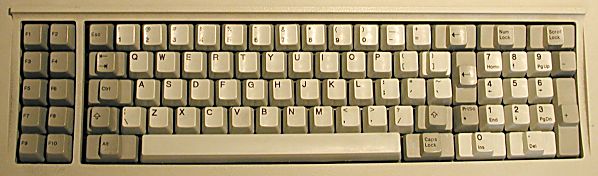
|
Closeup photo of an original IBM PC/XT keyboard,
showing its layout. |
Here are some of the main issues with this layout, when it is contrasted to more modern
configurations (note that while you may not care all that much about this very old
design--and I don't blame you--reading this list will help you understand the changes made
in later designs):
- Cramped Physical Grouping: Just looking at it, you can see that it is a very
"cramped" layout. All of the keys except the function keys are physically
contiguous, giving the layout a very "busy" appearance. This is made worse by
the fact that so many keys are of odd sizes, and there is no clear vertical "dividing
line" for the eye between the main typing area and the numeric keypad. Even the
function keys are not separated very much from the rest of the layout. Overall, it looks
like a "jumble of keys". This may seem a trivial matter but has an impact on
those learning to use the PC.
- Poor <Shift> Key Size and Location: IBM made the <Shift> keys rather
small, and even worse, placed an extra key (backslash and vertical bar) between
"Z" and the left <Shift> key, causing touch typists fits when attempting
to use the keyboard. Lots of extra backslashes being backspaced over all the time. :^)
- Poor <Enter> Key Size and Location: Same story for the <Enter> key;
rather small, and too far to the right, with an extra, rarely needed key (back-quote and
tilde) between the main typing area and the <Enter> key. Notice how the
<Enter> key doesn't line up with the right <Shift> key. Another problem with
the <Enter> key is simply the fact that it doesn't even say "Enter" on it!
There were a lot of newcomers to PCs in the early 1980s who had no idea what an
"Enter" key even was.
- Strange <Ctrl> Key Size and Position: Many users found the <Ctrl> key
to be too large and in the place where they expected to find the <Caps Lock> key. In
turn, the <Caps Lock> key is in an odd location. (I personally prefer this design,
because the <Ctrl> key is used a lot more than the <Caps Lock> key, but I
believe I am in the minority in this opinion.)
- No Dedicated Cursor and Navigation Keys: The only cursor
and navigation keys are the ones on the numeric keypad.
Since the cursor and navigation keys are needed almost all the time, this greatly reduced
the utility of the numeric function of that keypad. (Remember that the most popular
application in the early days of the PC was Lotus 1-2-3, a spreadsheet program used by
financial people who needed both cursor movement keys and the numeric keypad...)
- No Indicator LEDs: These early keyboards communicated unidirectionally with the
system and could not accept the commands now used to control the indicator LEDs, so they included none. This caused much
confusion, particularly given the frequency with which the <Num Lock> key needed to
be pressed! Some PC clone keyboards came out with indicator LEDs on them that were
controlled by the keyboard itself. These mostly worked OK, but had the potential for
becoming "out of sync" with what the system thought the state of the toggle
modifier keys was.
- Left-Side Function Keys: Many people hated having the function keys on the left
hand side of the keyboard. Part of the reason for this is that early software would often
provide visual cues on the bottom of the screen indicating what roles the different
function keys would play in that application, and many users wanted to see the function
keys "line up" with these cues.
As mentioned in the section on signaling, these
older keyboards are electrically incompatible with modern PCs. They are almost never seen
any more except on any early PCs that are still running (and they are indeed still out
there...) For a while in the mid-1980s many keyboards were manufactured with a switch to
enable emulation of an 83-key keyboard for the sake of older PCs.
 Next: 84-Key AT Keyboard Layout Next: 84-Key AT Keyboard Layout
Home - Search
- Topics - Up
| |
