[ The PC Guide | Systems
and Components Reference Guide | Keyboards ]
Keyboard Key Groupings
Having looked at the physical construction and low-level operation of the keyboard, we
now can turn out attention to higher-level considerations of its logical operation. I will
start by first listing and discussing each of the keys found in a typical, modern
keyboard. Obviously, each specific key doesn't need an explanation, but certain keys have
interesting attributes or histories that I think are useful to know.
There are over 100 keys on a modern keyboard. Rather than discuss them all in one
monstrous page, I have divided them into logical groups based on function. These are to
some extent my own decision based on how I see the keys being organized. These logical
groupings resemble the physical groupings you see when you look at some keyboards, but not
completely. Physical groupings are more a function of keyboard layout, discussed elsewhere.
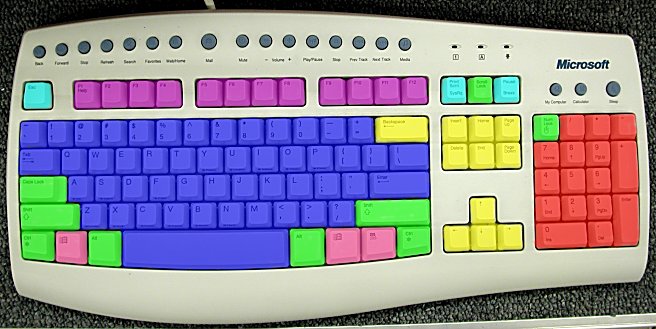
|
A Microsoft keyboard, with the major key groups shaded
to show their locations.
Regular alphanumeric and punctuation keys are blue; modification keys are green;
cursor control and navigation keys are yellow; the numeric keypad is red; function keys
are purple; "special" keys are cyan; and Windows keys are pink. In addition, a
number of
additional buttons for activating special functions are shown along the top of the
keyboard.
(Thanks to Staples for letting me take the
original photo for this illustration, in one of their stores.) |
So in this section I take a more detailed look at the various groups of keys found on
the modern keyboard. Where appropriate, I describe the various keys and what they do. Also
included for each key group is a table, which shows all the keys in that group along with
their normal "make" and "break" scan codes,
and their sequential "key number" as first defined by IBM. Notes on the scan
code tables:
- All scan codes are shown in hexadecimal notation.
- The scan code tables contain all the keys from the standard 104-key Windows keyboard
design. I also mention certain keys that differ on United Kingdom keyboards. I do not
cover non-English keyboards, sorry.
- The keyboard scan codes shown are for the normal keyboard operating mode, sometimes
called scan mode 1. There are also two other scan modes, called (unsurprisingly) mode
2 and mode 3 which are not typically used any more, and are not shown (to
prevent the tables from becoming unnecessarily complex).
- Most scan codes are a single byte (eight bits). However, some are two bytes or more,
particularly special characters. In some cases the reason for these multiple byte codes is
because they were added later to the original IBM keyboard designs.
- The "break" code is normally calculated by adding 80h to the "make"
code, though this is not true of every key.
 Next: Regular
Alphanumeric and Punctuation Keys Next: Regular
Alphanumeric and Punctuation Keys
Home - Search
- Topics - Up
| |
