[ The PC Guide | Systems and Components Reference Guide | Hard Disk Drives | Hard Disk
Performance, Quality and Reliability | Redundant Arrays of
Inexpensive Disks (RAID) | RAID Configuration and Implementation
| RAID Controllers and Controller Features ]
Hardware RAID
Most "serious" RAID implementations use what is termed hardware RAID.
This means using dedicated hardware to control the array, as opposed to doing array
control processing via software. Good hardware controllers are in many ways like miniature
computers, incorporating dedicated processors that exceed the power of processors that ran
entire PCs just a few years ago. For a list contrasting software and hardware RAID,
showing the advantages and disadvantages of each, see this page on software RAID.
There are two main types of hardware RAID, differing primarily in how they interface
the array to the system:
- Bus-Based or Controller Card Hardware RAID: This is the more
conventional type of hardware RAID, and the type most commonly used, particularly for
lower-end systems. A specialized RAID controller is installed into the PC or server, and
the array drives are connected to it. It essentially takes the place of the SCSI host
adapter or IDE/ATA controller that would normally be used for interfacing between the
system and the hard disks; it interfaces to the drives using SCSI or IDE/ATA, and sends
data to the rest of the PC over the system bus (typically PCI). Some motherboards, particularly
those intended for server systems, come with some variant of integrated RAID
controller. These are built into the motherboard, but function in precisely the same
manner as an add-in bus-based card. (This is analogous to the way that the integrated
IDE/ATA controllers on all modern motherboards function the same way that add-in IDE/ATA
controllers once did on older systems.) The only difference is that integrated controllers
can reduce overall cost--at the price of flexibility.
- Intelligent, External RAID Controller: In this higher-end design, the
RAID controller is removed completely from the system to a separate box. Within the box
the RAID controller manages the drives in the array, typically using SCSI, and then
presents the logical drives of the array over a standard interface (again, typically a
variant of SCSI) to the server using the array. The server sees the array or arrays as
just one or more very fast hard disks; the RAID is completely hidden from the machine. In
essence, one of these units really is an entire computer unto itself, with a
dedicated processor that manages the RAID array and acts as a conduit between the server
and the array.
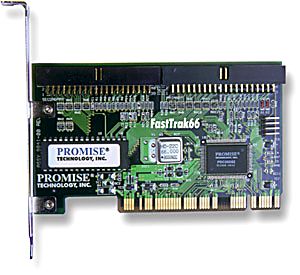
|
A PCI-bus-based, IDE/ATA hard disk RAID
controller, supporting levels 0, 1, and 01.
(Promise's popular FastTrak 66.) |
Original image © Promise Technology Inc.
Image used with permission. |
Bus-based RAID is cheaper and much simpler to implement than external RAID controllers
while still offering often impressive capabilities; they range from entry-level cards for
IDE/ATA systems that cost around $100, up to top-of-the-line, full-featured devices
costing several thousand dollars. Dedicated, external RAID controller systems are still
more expensive but offer many advanced features, are typically more expandable than
bus-based RAID implementations (offering support for large array well into the terabytes) and can offer better performance.
They often cost well into the five figures, so they are not something a typical PC user
would even consider.
 Note: External RAID
controllers should not be confused with external RAID enclosures. Enclosures provide power and physical infrastructure for
the drives in a RAID array, but not the smarts of the controller; they are functionally a
large, fancy PC system case. An external RAID controller can be thought of as such an
enclosure combined with a high-end, integrated controller as well. Note: External RAID
controllers should not be confused with external RAID enclosures. Enclosures provide power and physical infrastructure for
the drives in a RAID array, but not the smarts of the controller; they are functionally a
large, fancy PC system case. An external RAID controller can be thought of as such an
enclosure combined with a high-end, integrated controller as well.
In most cases, the decision to use hardware RAID is made almost exclusively on
financial grounds: hardware RAID is superior to software RAID in virtually every way, it
just costs more. If you want to use any of the more esoteric RAID levels such as RAID 3 or RAID
1+0, you pretty much require hardware RAID, since support for these levels is usually
not offered in software. If you need top performance while using a computation-intensive
RAID level such as RAID 5, you also should
consider a hardware solution pretty much "mandatory", because software RAID 5
can really hurt performance.
 Next: Software RAID Next: Software RAID
Home - Search
- Topics - Up
| |
