[ The PC Guide | Systems and Components Reference Guide | Hard Disk Drives | Hard Disk Interfaces
and Configuration | Small Computer Systems Interface (SCSI) | SCSI Cables and Connectors ]
Wide (68-Conductor) Single-Ended Cables, Connectors and Signals
Wide cables are used for wide (16-bit) SCSI transfer modes. These are also sometimes called 68-conductor
or 68-pin cables after the number of wires in the cable or pins in its
connectors, respectively. Wide cables are formally called "P" cables in
the SCSI standards, though there are several different types of "P" cables.
 Note: Wide SCSI was
defined in the SCSI-2 standard, many years after narrow SCSI
was already established. The first wide SCSI implementations were designed to use a 68-pin
"B" cable in combination with the regular narrow
"A" cable. This combination was cumbersome and expensive, and very unpopular
in the hardware industry. The "P" cable replaced the "A+B" combination
and is now the standard for wide SCSI implementations. Note: Wide SCSI was
defined in the SCSI-2 standard, many years after narrow SCSI
was already established. The first wide SCSI implementations were designed to use a 68-pin
"B" cable in combination with the regular narrow
"A" cable. This combination was cumbersome and expensive, and very unpopular
in the hardware industry. The "P" cable replaced the "A+B" combination
and is now the standard for wide SCSI implementations.
Wide SCSI uses 68 signals, carried on the 68 conductors in the cable. These are
organized into 34 pairs of two wires each. For single-ended
SCSI, each pair generally consists of a signal and a signal return, which is the
same as a ground line. The numbering of the signals is different for the cable conductors
and the connector pins, though fortunately there is only one set of pin numbers, unlike
narrow SCSI (see the narrow SCSI cable description for more).
Here are the signals and numbering conventions for wide SCSI:
Signal |
Pin # |
Cable
Conductor
# |
Pin # |
Signal |
SIGNAL RETURN |
1 |
1 |
2 |
35 |
-DB(12) |
SIGNAL RETURN |
2 |
3 |
4 |
36 |
-DB(13) |
SIGNAL RETURN |
3 |
5 |
6 |
37 |
-DB(14) |
SIGNAL RETURN |
4 |
7 |
8 |
38 |
-DB(15) |
SIGNAL RETURN |
5 |
9 |
10 |
39 |
-DB(P1) |
SIGNAL RETURN |
6 |
11 |
12 |
40 |
-DB(0) |
SIGNAL RETURN |
7 |
13 |
14 |
41 |
-DB(1) |
SIGNAL RETURN |
8 |
15 |
16 |
42 |
-DB(2) |
SIGNAL RETURN |
9 |
17 |
18 |
43 |
-DB(3) |
SIGNAL RETURN |
10 |
19 |
20 |
44 |
-DB(4) |
SIGNAL RETURN |
11 |
21 |
22 |
45 |
-DB(5) |
SIGNAL RETURN |
12 |
23 |
24 |
46 |
-DB(6) |
SIGNAL RETURN |
13 |
25 |
26 |
47 |
-DB(7) |
SIGNAL RETURN |
14 |
27 |
28 |
48 |
-P_CRCA |
GROUND |
15 |
29 |
30 |
49 |
GROUND |
GROUND |
16 |
31 |
32 |
50 |
GROUND |
TERMPWR |
17 |
33 |
34 |
51 |
TERMPWR |
TERMPWR |
18 |
35 |
36 |
52 |
TERMPWR |
(reserved) |
19 |
37 |
38 |
53 |
(reserved) |
GROUND |
20 |
39 |
40 |
54 |
GROUND |
SIGNAL RETURN |
21 |
41 |
42 |
55 |
-ATN |
GROUND |
22 |
43 |
44 |
56 |
GROUND |
SIGNAL RETURN |
23 |
45 |
46 |
57 |
-BSY |
SIGNAL RETURN |
24 |
47 |
48 |
58 |
-ACK |
SIGNAL RETURN |
25 |
49 |
50 |
59 |
-RST |
SIGNAL RETURN |
26 |
51 |
52 |
60 |
-MSG |
SIGNAL RETURN |
27 |
53 |
54 |
61 |
-SEL |
SIGNAL RETURN |
28 |
55 |
56 |
62 |
-C/D |
SIGNAL RETURN |
29 |
57 |
58 |
63 |
-REQ |
SIGNAL RETURN |
30 |
59 |
60 |
64 |
-I/O |
SIGNAL RETURN |
31 |
61 |
62 |
65 |
-DB(8) |
SIGNAL RETURN |
32 |
63 |
64 |
66 |
-DB(9) |
SIGNAL RETURN |
33 |
65 |
66 |
67 |
-DB(10) |
SIGNAL RETURN |
34 |
67 |
68 |
68 |
-DB(11) |
Note: "-P_CRCA"
was "-DB(P0)" (parity zero) before the introduction of CRC.
The numbering of the conductors alternates between the left column of signal returns
and the right column of signals, facilitating the creation of matched
pairs within the cable, and also allowing for the creation of "partially twisted
pair" LVD cables. The pins are numbered sequentially
down the left column, and then the right column. This probably facilitates manufacturing
in some way.
In practical terms, the following are the most common "P" cables used in the
PC world for single-ended wide SCSI:
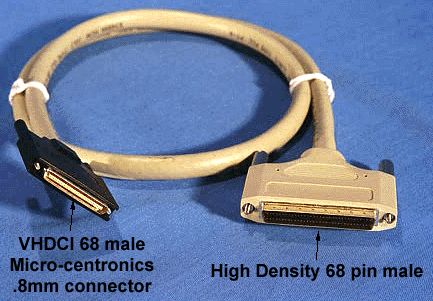
- External High Density Cables: The older style of external wide cables
uses the larger high density connector.
- External Very High Density Cables: The newer style of external wide
cables uses the very high density (VHDCI) connector. It is most common with the newest
devices (though typically, VHDCI cables use LVD, not single-ended signaling.)
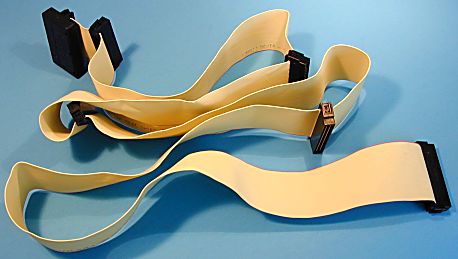
- Internal High Density Cables: Only one general type of internal wide
cable is used for single-ended signaling, a 68-wire ribbon cable with high density
connectors.
|
Above, an external wide cable that has one high density
connector and one very high density connector. Below, an
internal wide cable with five high density connectors. Note the
integrated terminator on the internal connector (upper left). |
Top image © Computer Cable Makers, Inc.
Image used with permission. |
As with narrow SCSI, the choice of external cable depends on the requirements of the
hardware being used. There are cables available that have mixed connector types for
special requirements, and also many kinds of adapters.
Note that high-end SCSI now uses LVD, so LVD cables are
required, which are similar in some ways to single-ended "P" cables, yet
different. ;^) They are also, unfortunately, called "P" cables, so watch out for
that! Note also that some wide SCSI implementations use single
connector attachment (SCA) instead of discrete cables.
 Next: Low Voltage Differential (LVD) Cables, Connectors and Signals Next: Low Voltage Differential (LVD) Cables, Connectors and Signals
Home - Search
- Topics - Up
| 