[ The PC Guide | Systems and Components Reference Guide | Hard Disk Drives | Hard Disk Interfaces
and Configuration | Small Computer Systems Interface (SCSI) | SCSI Cables and Connectors ]
Single Connector Attachment (SCA, SCA-2)
The SCSI standards define four "alternative" connector
types for both internal and external SCSI connections. Of those eight, seven involve
the use of traditional SCSI cabling of one sort or another. Internal connection
"Alternative 4", however, defines a totally different way of connecting SCSI
drives to host systems. Instead of the use of discrete cables, the drives are plugged
directly into the system. A single connector is used that includes all of the signaling
and power inputs and outputs needed by the drive. This technique is called single
connector attachment or SCA.
The reason why this attachment method was developed was to respond to the needs of
higher-end systems. Better workstations and servers now employ advanced technology to
allow multiple hard disks to be used together to increase performance and improve
reliability. This is done through the use of Redundant
Arrays of Inexpensive Disks (RAID); these high-end machines may have anywhere from two
to dozens of SCSI drives in them. One important feature of RAID is hot swapping, which means that failed
hard disks can be removed from the disk array and replaced with new ones without powering
down the system. This allows busy machines to keep on running even if a drive fails.
Conventional attachment protocols with separate power and data cables--and manual
configuration--do not work well in this environment. Regular SCSI hard disk connection
methods don't allow for hot swapping. In addition, all the cables involved in connecting
power and data to a dozen drives are cumbersome
With the SCA system, the regular 68-pin data connector, 4-pin power connector, and
several configuration jumpers on a hard disk are all replaced by a single, unified 80-pin
connector. (Incidentally, SCA is a wide-only interface; there
is no narrow SCA). This is a Centronics-style connector with special properties used to
ensure safe hot plugging of devices into an active system. On the host side, mating
connectors are mounted onto a backplane consisting of several removable drive
bays (you can see a picture of a server case
providing removable SCSI SCA drive bays here.)
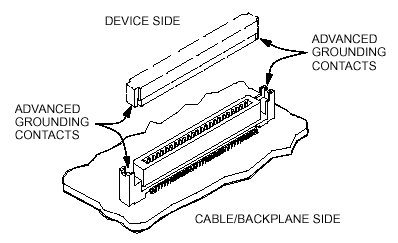
|
Simplified schematic showing how SCA SCSI works.
The female connector is on the backplane within the PC,
and the male attached to the device (typically a hard disk).
The advanced grounding contacts allow hot swapping without
creating electrical problems (see further down the page for more). |
Image © Information
Technology Industry Council (ITI)
(See here for more on ITI.) Image
used with permission. |
The first SCA implementation had some issues, and the technology was revised in a new
version now called SCA-2. Several attributes about the interface were changed
with this new version of SCA, and SCA-2 is now the standard in the industry. In order to
frame the discussion of the features of SCA, let's take a look at the single-ended signals and contact numbering scheme for the current
standard 80-contact SCA connector:
Signal |
Long Host
Contact? |
Connector
Contact # |
Long Host
Contact? |
Signal |
12V CHARGE |
YES |
1 |
41 |
YES |
12V GROUND |
12V |
|
2 |
42 |
YES |
12V GROUND |
12V |
|
3 |
43 |
YES |
12V GROUND |
12V |
|
4 |
44 |
|
MATED 1 |
3.3V |
|
5 |
45 |
YES |
3.3V CHARGE |
3.3V |
|
6 |
46 |
YES |
GROUND |
-DB(11) |
|
7 |
47 |
|
SIGNAL RETURN |
-DB(10) |
|
8 |
48 |
|
SIGNAL RETURN |
-DB(9) |
|
9 |
49 |
|
SIGNAL RETURN |
-DB(8) |
|
10 |
50 |
|
SIGNAL RETURN |
-I/O |
|
11 |
51 |
|
SIGNAL RETURN |
-REQ |
|
12 |
52 |
|
SIGNAL RETURN |
-C/D |
|
13 |
53 |
|
SIGNAL RETURN |
-SEL |
|
14 |
54 |
|
SIGNAL RETURN |
-MSG |
|
15 |
55 |
|
SIGNAL RETURN |
-RST |
|
16 |
56 |
|
SIGNAL RETURN |
-ACK |
|
17 |
57 |
|
SIGNAL RETURN |
-BSY |
|
18 |
58 |
|
SIGNAL RETURN |
-ATN |
|
19 |
59 |
|
SIGNAL RETURN |
-P_CRCA |
|
20 |
60 |
|
SIGNAL RETURN |
-DB(7) |
|
21 |
61 |
|
SIGNAL RETURN |
-DB(6) |
|
22 |
62 |
|
SIGNAL RETURN |
-DB(5) |
|
23 |
63 |
|
SIGNAL RETURN |
-DB(4) |
|
24 |
64 |
|
SIGNAL RETURN |
-DB(3) |
|
25 |
65 |
|
SIGNAL RETURN |
-DB(2) |
|
26 |
66 |
|
SIGNAL RETURN |
-DB(1) |
|
27 |
67 |
|
SIGNAL RETURN |
-DB(0) |
|
28 |
68 |
|
SIGNAL RETURN |
-DB(P1) |
|
29 |
69 |
|
SIGNAL RETURN |
-DB(15) |
|
30 |
70 |
|
SIGNAL RETURN |
-DB(14) |
|
31 |
71 |
|
SIGNAL RETURN |
-DB(13) |
|
32 |
72 |
|
SIGNAL RETURN |
-DB(12) |
|
33 |
73 |
|
SIGNAL RETURN |
5V |
|
34 |
74 |
|
MATED 2 |
5V |
|
35 |
75 |
YES |
5V GROUND |
5V CHARGE |
YES |
36 |
76 |
YES |
5V GROUND |
SPINDLE SYNC |
YES |
37 |
77 |
YES |
ACTIVE LED OUT |
RMT_START |
YES |
38 |
78 |
YES |
DLYD_START |
SCSI ID (0) |
YES |
39 |
79 |
YES |
SCSI ID (1) |
SCSI ID (2) |
YES |
40 |
80 |
YES |
SCSI ID (3) |
Looking at this table, you will notice several differences compared to the signal chart for regular wide SCSI attachment. These really
define the special characteristics of the SCA interface:
- Regular Signals: The "core" SCSI signals are the same as for wide SCSI; they are found in the middle part of the connector.
The only difference is that the signals are in the left column and the returns on the
right, instead of the other way around.
- Power Signals: Three voltages of power are supplied to the hard disks:
3.3 V, 5 V and 12 V. Again, these are provided so that the drive can operate without
needing a separate Molex-style four-pin power connector.
- Long Contacts: The "Long Host Contact?" column has the word
"YES" in it for several contacts. The connector on the host (PC) side is
specially designed so that these contacts are made a bit longer than the regular length
associated with most of the contacts in the connector. This is an important feature: what
it does is to ensure that these signals make contact before any others when a drive is
inserted, and also that they break contact last when a drive is removed. Without
this feature, subtle changes in the angle of insertion or pressure applied to the drive as
it is pushed into the system could cause spurious results--a voltage contact might connect
before the ground contacts, for example. (Remember that compared to the speed of
electricity, human hands are extremely slow; even the split-second that passes while a
connector is being seated represents an eternity to electronic circuits.)
- Power Charge Signals: Each of the three voltages mentioned above has
associated with it a "precharge" signal. These are on long contacts while the
regular voltage signals are on short contacts. When a drive is inserted, these precharge
circuits make contact a bit before the regular voltage circuits do. A drive can be
designed to use these charge signals to "precharge" its internal circuits during
hot plugging, to soften the sudden "surge" of current when the regular power
signals connect.
- SCSI ID Signals: Instead of using jumpers, SCA drives have their device
IDs set through software control. This is obviously important to enable the use of many
drives and hot swapping.
- Other Control Signals: Extra signals are provided to allow control over
other drive features such as remote or delayed starting of the drive motor. A signal is
also provided for the drive to indicate that it is active, so the system can light the
appropriate drive activity LED.
The physical SCA connectors also incorporate physical features to make hot plugging of
drives easier. SCA drives slide into drive bays and mate with the system connector in the
back without the user being able to see what is going on; this is called blind
connector mating. To ensure that the connectors line up properly, special guides are
provided on the host connector.
There is also an LVD version of the SCA interface, which is
now taking over from the single-ended type of SCA, as all new hard disks use LVD. The
difference between LVD SCA and SE SCA is the same as the
difference between LVD wide cable signals and SE wide cable signals: there are two
changes. The first is that all of the signal returns are replaced with positive complement
signals; for example, contact #58 on an LVD SCA connector is "+BSY", and so on.
The second is that one ground is replaced by the DIFFSENS signal, in this case contact
#46.
 Warning: Though
physically identical, LVD drives must use the LVD version of the SCA interface to function
properly. Warning: Though
physically identical, LVD drives must use the LVD version of the SCA interface to function
properly.
 Next: SCSI Adapters Next: SCSI Adapters
Home - Search
- Topics - Up
| |
