[ The PC Guide | Introduction to
the PC | PC Fundamentals | Signaling,
Clocks and Synchronous Data Transfer ]
Clock Signals, Cycle Time and Frequency
As I mentioned in the previous page of this section, the
dimension of change in the operation of signals is time. Signals change as time
progresses, and this is what enables the flow of data, in fact, everything that happens
within a PC. With so many circuits within a computer, it is necessary for some sort of
synchronization to occur. Otherwise, the PC would be a like a symphony without a
conductor.
The "conductor" of the PC is the system clock. A clock is just a
signal that alternates between zero and one, back and forth, at a specific pace. In many
ways, it is just like a metronome, going back and forth over and over. The clock sets the
"pace" for everything that happens within a particular electronic circuit.
There are a few important terms and attributes related to clock signals, which you will
occasionally hear mentioned:
- Cycle: This refers to a single complete traversal of the signal, from the rising
edge, through the time when the value of the clock is one, through the falling edge, the
time that the value is zero, until the start of the next rising edge. (You can actually
"chop" the signal wherever you want and have it be a single cycle, as long as
you only cover one cycle without "overlapping").
- Cycle Time: The amount of time required for the signal to traverse one complete
cycle. For fast PC circuits, cycle time is often specified in ns (nanoseconds, or
billionths of a second). Sometimes also called cycle length or similar names.
- Rise Time and Fall Time: In theory, the transition from a one to a zero or
vice-versa is instantaneous. In practice, nothing is instantaneous, and the rise time
and fall time measure how long it takes for the level to change from zero to one,
or one to zero, respectively.
- Clock Frequency: This is also sometimes called the clock rate or clock
speed. It is simply the reciprocal of the cycle time, and is therefore the number of
cycles that occur each second (as opposed to the number of seconds per cycle). It is
usually measured in MHz or GHz, where "Hz" is the abbreviation for Hertz,
the standard SI unit for measuring frequency. One
Hertz is one cycle per second. So for example, if a clock's cycle time is 1.25 ns, its
frequency is 1/(0.00000000125) = 800,000,000 Hertz, or 800 MHz.
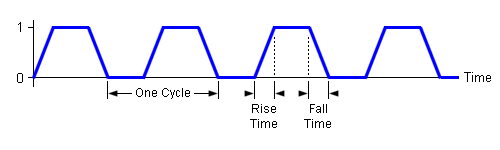
|
A clock signal.
This diagram shows just under four complete cycles of a typical clock signal.
The span of a single cycle is shown, along with the time periods that represent
rise time and fall time. (The scale of the time axis would be needed to know what
the actual cycle time, and hence frequency, of this example clock signal is.) |
Where do these clock signals come from in the first place? That's a very good question.
In fact, they are generated the same way that a digital watch (or any electronic
timepiece) keeps time. A special circuit called an oscillator supplies a small
amount of electricity to a crystal. Crystals are special components made out of
components such as quartz, which vibrate at a particular frequency when energized. By
controlling the characteristics of the crystal and the rest of the circuit, the specific
speed of the clock can be determined fairly precisely. Some oscillator circuits also
provide additional components to allow the same crystal to generate a variety of different
clock speeds, perhaps even under software control.
 Note: In some contexts, a clock
signal may be called a strobe or other similar name. Note: In some contexts, a clock
signal may be called a strobe or other similar name.
 Next: Derived System Clocks Next: Derived System Clocks
Home - Search
- Topics - Up
| |
